
The Great AI Software Gold Rush
The Great AI Software Gold Rush
Are We Actually Helping Carwash Businesses Anymore?
By Mel Ohlinger, Founder & CEO of OhmCo
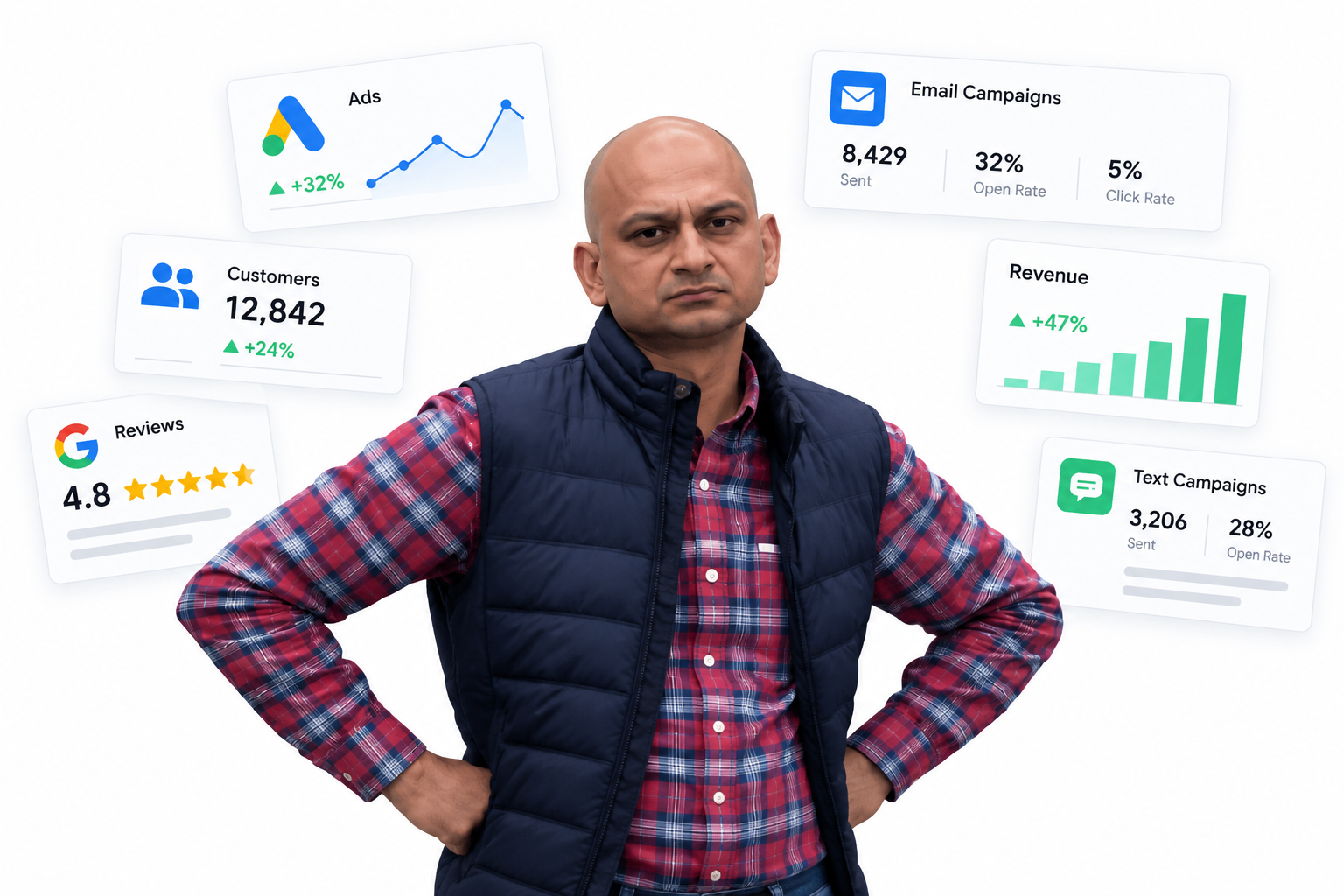
Having everything under one company sounds like a smart way to simplify operations, but it isn't necessarily a smart way to protect your business. I've been thinking about this quite a bit lately as more technology companies enter the carwash industry promising to revolutionize everything from customer acquisition to membership retention. I'm an enthusiastic supporter of technology (particularly artificial intelligence) but I'm becoming increasingly concerned about the direction we're heading. And will these businesses and innovations are actually benefiting the businesses they're supposed to serve? Or are they they new snake oil?
There's a familiar pattern emerging in our industry. A new company arrives with a nearly naked website, a collection of AI-powered features, and vague buzz word promises to simplify everything. Suddenly, your website, memberships, customer communications, advertising, marketing automation, and analytics can all be handled by one provider. For a busy carwash operator, the appeal is understandable. Managing multiple vendors can be frustrating, especially when those companies need to share information or troubleshoot problems together. And historically, we've been really awful in this industry with working with our competitors. I've seen some of those emails that weren't supposed to be shared... it's not pretty! SO I get why consolidating everything into one relationship seems like a reasonable solution, and in some circumstances, it probably is. What is driving me crazy right now is how easily convenience becomes the selling point for technology that business owners may not fully understand. Some of these supposedly revolutionary platforms are built on existing software that has simply been rebranded and repackaged for a particular industry. HighLevel (formerly commonly called GoHighLevel) is a good example of a legitimate software company that allows agencies to white-label its CRM, marketing automation, and other tools. Agencies can customize the platform, put their own branding on it, and resell it to customers. There's nothing inherently dishonest about that arrangement, and OhmCo also uses established technology developed by other companies. It would be financially impractical for most small agencies to develop every component of their technology independently.
The problem arises when the distinction between developing technology and reselling it becomes unclear, particularly when a company markets existing software as though it has invented something entirely new. I believe customers deserve to understand what they're purchasing. I also think they should expect to work with people at a company who actually develops and maintains the underlying technology, and what they're paying the reseller to provide. There is tremendous value in configuring software, building integrations, providing technical support, and understanding how to apply technology to a specific industry. Those services require genuine expertise, and a company should be able to charge appropriately for them without creating the impression that it invented the technology itself. But that's not what's happening.
I've watched variations of this business model appear throughout my career, and it reminds me of the enormous gold mine called SEO. An entire industry developed around convincing small businesses their websites were fundamentally broken. Search engine optimization is a legitimate discipline, and sophisticated technical SEO can be complicated, but much of the work required on an ordinary small-business website is surprisingly similar to editing an essay. You improve the organization, clarify the subject, write descriptive headings, correct errors, and make information easier to find. There are technical requirements, of course, but many businesses were encouraged to spend thousands of dollars addressing problems that were presented as far more mysterious than they actually were. And I'm seeing that exact pattern happen again with technology consolidation grift.
I have a BFA in design, and I've spent much of my career studying how people receive, interpret, and respond to information. Good design, effective marketing, and accessible technology all depend on understanding how people think and communicate. That's why I find it frustrating when relatively straightforward problems are transformed into complicated technical projects, particularly when the person offering the solution doesn't appear to understand the technology well enough to maintain it.
Earlier this year I encountered a situation involving someone responsible for a customer's website who needed to add a small piece of code to the website's header for tracking purposes for a HighLevel connection. This is a fairly routine website maintenance task, and someone with basic website development experience should be able to accomplish it without rebuilding anything. I gave the person a login and access to stick it in the website. Instead, the person couldn't figure out how to make the change and resorted to using AI to regenerate the entire website, and then sold the carwasher on moving all their technology "under one platform" instead of being honest about what was really going on. What should have been a relatively simple adjustment became an unnecessarily complicated process, costing my carwasher thousands of dollars because the foundational technical knowledge wasn't there. I figured it was a one-off, but couldn't stop thinking about it.
I found the experience particularly troubling because I love AI and use it extensively in my own work. It helps me research, write code, develop ideas, troubleshoot problems, and approach projects that might otherwise require hours of repetitive work. I especially love it for checking statistics and adding links to my sources and organizing my sources when I write. I'm also very proud that I have enough experience to recognize when the output doesn't make sense. I understand the fundamentals of what I'm asking the technology to accomplish, and I can usually identify when an answer needs to be corrected or reconsidered, and I love using AI as a way to save time and be able to do something in days that used to take me days and even months to make. But with this shift, I'm worried that as these tools become more accessible, we're creating opportunities for people to offer technical services without developing the knowledge necessary to evaluate or maintain what they've produced. They're selling things that they have no idea what they can do (and as we've seen that always comes with a huge security issue down the road. Microsoft is down today for a reason, haha).
But while I would love to take accountability for my online grumblings, there is research supporting this concern. Stack Overflow's 2025 Developer Survey found that 84% of respondents were using or planning to use AI tools, while 46% said they distrusted the accuracy of AI-generated output. Approximately two-thirds reported frustration with AI-generated solutions that were almost correct but still required intervention, and 45% said debugging AI-generated code was time-consuming. These findings suggest that although AI is becoming an ordinary part of software development, the ability to evaluate its output and fix any erros remains essential.
A January 2026 study by Anthropic examined how AI assistance affected developers learning to use an unfamiliar programming library. Participants who relied on AI assistance scored approximately 17% lower on a subsequent assessment of their understanding than those who completed the work without it. The experiment involved only 52 developers, so it shouldn't be interpreted as proof that AI generally reduces technical ability. However, the researchers found meaningful differences in how participants used the technology. Those who used AI to ask questions and understand concepts retained more knowledge than those who delegated the work and accepted the results. While that seems totally obvious, sometimes it's nice to have a little data to reinforce the importance of using AI as a learning and problem-solving tool rather than a substitute for understanding.
One of the weirdest places I've been seeing this is in ordinary business communication. Email conversations that should take a few messages can become EXTRORDINARILY LONG because everyone is using AI to generate responses to sounds super professional and look good without taking the time to understand the issue being discussed. A customer describes a problem, someone produces an elaborate AI-generated explanation, another person replies with an equally elaborate response, and the conversation continues without anyone investigating what actually needs to be fixed. I just had an email thread 17 responses deep where no one had shared even one snippet of code, which was what was needed to fix the issue. What frustrates me isn't that people are using AI to help write emails. I do that myself sometimes! It's that producing a response has become more important than resolving the problem that prompted the email in the first place. (And I know it's because we all are chronically online and expected to reply in just a few minutes, but let's tackle that issue a different day, haha).
Nothing drives me more crazy than when people use the appearance of productivity to avoid any meaningful progress. I know we've all worked in corporate enviroments where we've expereinced that. I don't want to go back to that.
The ability to generate code, correspondence, advertising campaigns, and websites is remarkable, but generating something is only one part of the work. Understanding whether it's accurate, useful, appropriate, and maintainable is way more important. I don't believe everyone needs to become a programmer or marketing strategist, but I do believe people selling those services should possess enough foundational knowledge to take responsibility for their work. And that they should be teaching their customers about that information and what things mean and how they work.
This brings me to another aspect of the AI conversation that I find especially interesting. Technology companies are increasingly promoting AI-powered marketing, AI-powered customer engagement, AI-powered analytics, and AI-powered results. Given the amount of attention artificial intelligence receives, I understand why companies emphasize those capabilities. However, I keep wondering whether we're becoming so enthusiastic about automating customer relationships that we're forgetting the customers themselves are, in fact, human beings?
The people visiting our carwashes have families, jobs, preferences, frustrations, and reasons for choosing one business over another. Their decisions aren't always explained by a transaction history or a customer segmentation model. Someone might stop visiting because their favorite location changed its hours, because Logan wasn't at the pay station (haha) or maybe becuase the equipment wasn't working properly. Or it could be because an employee handled a difficult situation poorly. Another person might remain loyal for years because someone at the wash remembers their name or consistently makes their day a little easier. The greatest opportunity AI has is in helping people communicate more effectively with people. It can identify patterns that would be difficult to for the business to recognize manually, alert employees to customers who may need attention, and reduce the administrative work that takes time away from meaningful interactions. Those capabilities could make small businesses considerably more personal and responsive. While we start to replace genuine communication with increasingly elaborate automated marketing sequences, we are loosing that little tidbit- that this is really about humans.
Research suggests that customers still place considerable value on human interaction. PwC's 2025 Customer Experience Survey, which included 5,511 American consumers, found that 86% considered human interaction moderately or very important in their experiences with brands. The research also found that 29% had stopped purchasing from a brand because of poor customer experience. Although those findings aren't specific to carwashing, they're relevant to an industry that depends heavily on repeat visits, memberships, and customer satisfaction.
There's also good evidence that AI can improve customer service when implemented thoughtfully. A study published in The Quarterly Journal of Economics in 2025 examined AI assistance among more than 5,000 customer-support agents and found that employees using the technology resolved approximately 15% more issues per hour. Less-experienced workers benefited particularly strongly. And those results are encouraging because they demonstrate how AI can help people become more capable at their jobs without requiring businesses to eliminate the human relationship. The distinction matters because having access to more customer information doesn't automatically mean a business understands its customers better. An automated system might identify a membership customer who hasn't visited in several weeks, but the information is only useful if the business does something meaningful with it. Perhaps the customer would appreciate a reminder about their membership benefits, but perhaps they've experienced a problem that needs to be addressed. Sending another promotional offer may be appropriate in some circumstances, but it shouldn't become the automatic response to every customer behavior.
This is particularly important in the carwash industry because membership revenue has become such a substantial part of our business model. According to Rinsed's third-quarter 2026 industry report, which analyzed information from more than 3,000 carwash locations, memberships accounted for approximately 71% of same-store revenue. Membership revenue increased 9.8% year over year, while retail revenue declined 9.6%. The report also identified average monthly membership churn of 7.8%, including 4.5% from voluntary cancellations.
Those statistics deserve more attention than I think they're receiving. At a location with 1,000 members, a monthly churn rate of 7.8% would represent approximately 78 lost memberships in a single month. That doesn't mean every location experiences the same rate, but it illustrates how much effort can be required to maintain a membership base before achieving any meaningful growth. If operators are constantly replacing customers who leave, advertising can become an increasingly expensive way to maintain revenue rather than a sustainable strategy for expanding the business.
I regularly see businesses encouraged to invest heavily in advertising, new marketing technology, automated customer communication, and sophisticated acquisition campaigns. Those investments can absolutely be worthwhile, particularly when a location is opening or has significant growth potential. What concerns me is when that spending takes priority over improving the experience of customers who are already paying for the service.
If customers can't find accurate information about membership pricing, don't understand the terms of their subscriptions, or struggle to get assistance when something goes wrong, the business has operational and communication problems that deserve attention. A larger advertising budget might temporarily increase the number of new members, but it doesn't necessarily address the reasons existing members are dissatisfied (and in some cases it could simply expose more people to the same problems).
We have access to extraordinary amounts of information about advertising performance, conversion rates, membership signups, and customer behavior. Those metrics are valuable, but they should help us understand what people need rather than become the only measures of whether marketing is successful. A business that acquires hundreds of new members while neglecting the experience of its existing customers may have impressive acquisition numbers without building a particularly healthy long-term business. As my carwashers always say, you gotta put out a clean, dry, shiny car.
And that end product is what grinds my gears so much about thiss argument for consolidating all of these services under one technology provider. Historically, having one company manage several interconnected systems offered genuine practical advantages. Different platforms could be difficult and expensive to integrate, and coordinating multiple vendors required considerable technical expertise. It's why I've spent so much time making sure our OhmCo websites worked with EVERYBODY. However, APIs, cloud software, automation platforms, and artificial intelligence are changing the possibilities for connecting specialized services. And tech companies intentionally throttle connectivity in order to throttle integrations.
A carwash website doesn't need to be built by your membership provider to connect with its platform. Marketing software can communicate with POS systems, and customer information can move between platforms when the right integrations and permissions are in place. AI is making these connections even easier by helping systems interpret information and coordinate workflows. Of course, some companies still make integration unnecessarily difficult by restricting access to their data or charging excessive fees for API access. We pay close attention to which companies in the carwash industry do this because we believe technology should make it easier for businesses to operate, not more expensive to work with other providers. And yes, it genuinely pisses us off when companies put unnecessary barriers (and dollars) in the way of their own car washers.
I believe small business owners should evaluate consolidation based on whether it genuinely improves their operations, rather than assuming fewer vendors automatically means better service. A company might have excellent membership technology without having the same expertise in website design, advertising, or customer communication. I've been building websites for twenty years, and one of the things I've always taken pride in is continuing to learn and adapt as technology evolves. That experience matters, especially when it comes to understanding how things work and knowing how to fix them when they don't. But I'm also not going to pretend I'm a payment-processing developer (we have been asked to do that) or that OhmCo needs to build its own POS system (I've been asked to do that too). I'd much rather work with companies that specialize in those areas and bring our own expertise to the table. Small businesses should have the freedom to choose providers based on what each does best, without having to replace everything when their needs change. And I want to make sure I can offer that for digital marketing, social media marketing, graphic design and website development. And to be fair, that might already be too many hats for one company, haha.
But I totally get that there are legitimate advantages to having a single company coordinate technology, particularly when that company takes responsibility for making everything work together. However, customers should understand what happens if they eventually want to change one part of that relationship. Website ownership, domain control, data portability, software licensing, and the ability to transfer services are important considerations that aren't always obvious during the sales process. A website built on a proprietary platform may require rebuilding if the customer leaves, and some data or payment arrangements may not transfer easily between providers. If you change your membership platforms, do you really want to be building a whole entire website at the same time?
None of those limitations automatically makes a provider dishonest, but I believe companies have a responsibility to explain them clearly. When businesses are encouraged to consolidate essential operations without understanding the consequences of leaving, the convenience being advertised can become a substantial long-term liability.
There's another aspect of this conversation that is more personal for me, and I've struggled with how to discuss it because I don't want my frustration to overshadow the broader issues.
I'm a woman who founded a technology-focused marketing company in a predominantly male industry. I've spent years building relationships with carwash operators, studying their businesses, learning their technology, and developing services intended to make their operations and marketing more effective. I've taught internationally, worked with independent operators, and built a business around the idea that better communication and thoughtful design can make a meaningful difference. I genuinely love what I do, but I'd be lying if I said it wasn't frustrating to watch newer technology companies receive attention and recognition for concepts I've been working with for years. It really ticks me off to have these new companies come in, scan a website, and vibe code a copy cat website and sell that instead. It's not even legal, but they absolutly get away with it. And so many times I wonder whether my business would be perceived differently if I fit more naturally into the established networks where investment opportunities, partnerships, and acquisitions are discussed (aka, beign a dude, haha).
I recognize that I can't attribute every missed opportunity or difficult professional relationship to gender, and I certainly don't know the circumstances behind other companies' success. But I also can't ignore the disparities that exist. According to PitchBook and the National Venture Capital Association, companies with all-female founding teams received approximately 1.1% of U.S. venture capital investment in 2025. That doesn't tell us much about acquisitions in the carwash industry specifically, but it does illustrate how differently opportunities can be distributed. And when you've spent years building a company, developing expertise, and establishing relationships in a predominantly male industry, it's hard not to wonder how things might have been different.
I've never built OhmCo with the intention of flipping it for a quick payday. I love what we've created, and I care deeply about the people we work with. Someday, I'd like the option to sell the company, but I'd also like the work we've already done to be recognized and valued while we're still the ones doing it. I think there's room in this industry to celebrate the companies developing exciting new technology without overlooking the people who have spent years learning how to make that technology genuinely useful.
And that brings me back to what started this whole conversation. I believe we're becoming so focused on acquiring customers, selling software, and automating marketing that we're sometimes losing sight of the actual businesses and people we're supposed to be helping. An impressive advertising campaign isn't going to fix a consistently disappointing customer experience, and an AI-generated website isn't particularly valuable if nobody understands how to maintain it. Technology should make it easier for businesses to solve problems, communicate clearly, and take better care of their customers.
At OhmCo, we've organized our services around Web.Lab, Co.Lab, Data.Lab, and Design.Lab because websites, marketing, customer communication, and creative services are interconnected. But that doesn't mean every carwash needs to purchase every service from us. Our customers use different POS systems, membership platforms, and business tools, and I want them to have the flexibility to continue using the technology that works for them. Our responsibility is to understand those systems, explain the tools we're providing, and help customers make informed decisions. We certainly don't have every answer, but I think there's tremendous value in being willing to investigate a problem, learn something new, and take responsibility for the work.
I'm genuinely excited about what AI could mean for independent carwash operators. Small businesses now have access to analytical tools, automation, and technical capabilities that would have been difficult or prohibitively expensive just a few years ago. Used thoughtfully, these tools can help owners understand customer behavior, identify problems earlier, and give employees more time to focus on the people visiting their washes. I would love to see our industry use AI to strengthen the relationships that make independent businesses special, rather than treating automation as a reason to remove people from the process.
I also think we need to become a little more skeptical of what we're being sold. There's nothing wrong with using white-label technology, developing an all-in-one platform, or building a company with ambitions to grow and eventually sell. But I believe technology providers should be transparent about what they've created, what they've licensed, and what their customers are actually paying for. We should be asking whether new platforms deliver measurable improvements, whether customers can access and transfer their information, and whether the people selling these services have the experience to support them when something goes wrong.
After twenty years of building websites and working with businesses through countless changes in technology, I've learned that the tools will always evolve. What doesn't change nearly as much is what people need from the businesses they choose to support. They want reliable service, accurate information, fair treatment, and someone who will help when things go wrong. Those aren't particularly exciting selling points compared with the promise of an AI-powered revolution, but they're the foundation of a business people want to return to.
I hope the carwash industry continues to embrace new technology, and I hope we become better at recognizing the people and companies doing meaningful work with it. There's plenty of opportunity for innovation, collaboration, and growth without convincing every operator that they need to replace everything they already have. If we're going to encourage small businesses to invest thousands of dollars in new platforms, software, and advertising, we should be able to demonstrate how those investments improve their operations and customer relationships.
Ultimately, I think the most valuable technology will be the kind that gives carwash operators more control over their businesses, makes their employees more capable, and helps them take better care of their customers. That's the future I'd like to see our industry build, and it's the kind of work I want OhmCo to be part of. It's why we make sure you can login and access all your own stuff because I think that's where true value in technology lies.
Mel Ohlinger
Founder & CEO, OhmCo
Carwash Marketing + Technology
Research referenced: Rinsed, Q3 2026 Car Wash Industry Report; PwC, 2025 Customer Experience Survey; Stack Overflow, 2025 Developer Survey; Anthropic, AI Assistance and Coding Skills (2026); Brynjolfsson, Li, and Raymond, Generative AI at Work, The Quarterly Journal of Economics (2025); PitchBook–NVCA, 2025 Venture Monitor.